Article Forge renewals are coming due, and you are weighing whether to switch. Many platforms now cap credits, bury bulk tools behind higher tiers, or publish drafts that need a full rewrite. That math decides whether your autoblogging operation stays profitable.
This guide walks through the autoblogging buyer's checklist, from AI modes and one-click WordPress publishing to credit rollover, pricing tiers, and trust signals. By the end, you will know whether Autoblogging.ai fits your blog, agency, or client workload.
What Is Autoblogging.ai?
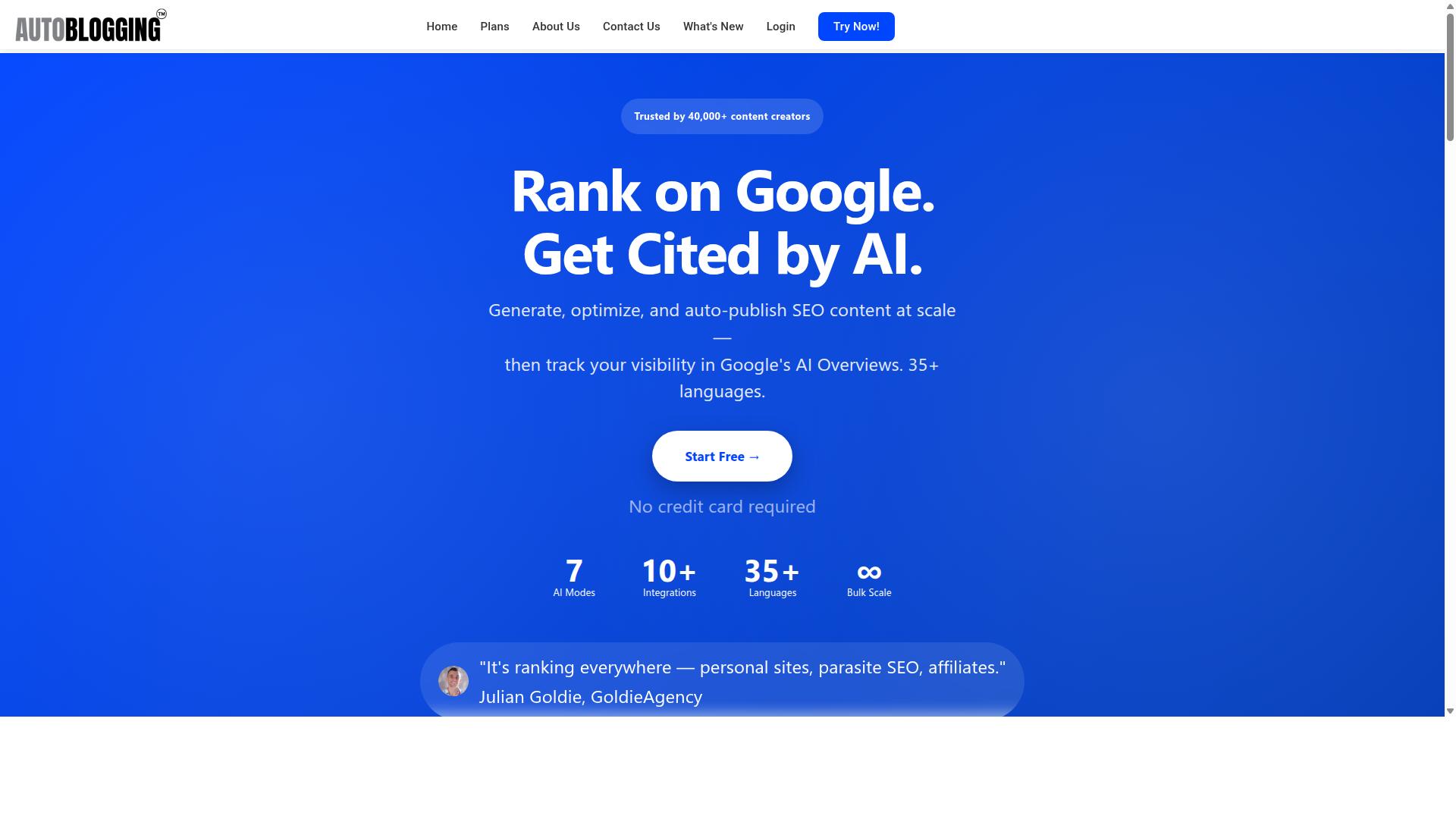
Autoblogging.ai is a cloud-based SaaS platform that automates the entire blog content creation process, from research to publishing, using advanced AI and machine learning. In practical terms, autoblogging describes the use of software to generate and publish blog content automatically, rather than writing and uploading every post by hand.
Autoblogging.ai is a product of Digimetriq.com, founded in 2022 by Vaibhav Sharda. The platform exists to serve bloggers, website owners, and agencies who want to publish consistently without spending hours on every draft.
Its core mission is straightforward: help these users save time and improve their online presence through cutting-edge technology. That mission shapes how the product is positioned, as a tool that removes repetitive production work so owners can focus on strategy, audience, and growth.
The brand also frames its purpose in economic terms. Autoblogging.ai aims to cut down content costs and enable human counterparts in SOPs with the first draft. Digimetriq, the company behind it, aims to replace human counterparts entirely.
Autoblogging.ai is available globally online, which means it serves a wide range of users regardless of location. A solo blogger building a niche site, a business owner maintaining a company blog, and an agency managing content for multiple clients all fall within its target audience.
For anyone comparing an Article Forge alternative, this context matters. Understanding who builds the tool, when it launched, and what problem it targets is the first step before evaluating features, output quality, or subscription pricing in later sections of this buyer's guide.
Why Autoblogging.ai Is the Article Forge Alternative Buyers Should Choose
When evaluating Article Forge alternatives, buyers should prioritize platforms that combine advanced AI, proven reliability, and transparent pricing-three areas where Autoblogging.ai consistently outperforms. Article Forge earned its reputation as an early content automation tool, but the market has moved quickly. Today's buyers expect more than basic article spinning; they want natural language generation that reads well, scales on demand, and fits into a real publishing workflow.
That shift explains why Autoblogging.ai has become a leading choice for autoblogging. The platform is trusted by 40,000+ content creators and holds a 4.9 average rating, with more than 1M+ articles generated to date. Those numbers matter in a buyer's guide because they reflect sustained use, not a one-time experiment.
Five decision factors separate the strongest options from the rest:
- Output quality: uniqueness, readability, and grammar that hold up without heavy editing
- Scalability: the ability to produce content in volume without losing consistency
- Integrations: publishing and workflow connections that reduce manual steps
- Support: responsive help when something breaks or a campaign stalls
- Cost: pricing that stays predictable as usage grows
Autoblogging.ai addresses each factor directly. It offers 10+ AI modes, support for 35+ languages, and 35+ integrations, along with credit rollover and 24/7 support. For buyers comparing an Article Forge alternative on overall value rather than a single feature, that combination is hard to match.
How Autoblogging.ai Solves the Autoblogging Buyer's Checklist
Autoblogging.ai directly addresses the critical checklist items that buyers use to evaluate content automation tools, from content quality and volume to SEO optimization and ease of use. Each criterion below maps to a specific capability rather than a vague promise.
Content quality. The platform includes an AI Proofreader and a Human Proofreader, the latter included in all plans. Godlike Mode adds SERP competitor analysis, LSI keywords, and knowledge graph extraction, which supports coherence and factual grounding rather than spun content.
Volume capacity. Bulk Generation produces up to 500 articles via CSV, a practical ceiling for autoblogging operations that publish daily across multiple sites.
SEO features. Buyers get a 21-point SEO audit through Semantic SEO Analysis, plus a Snippet Optimizer for featured snippet optimization, Topical Maps, Fan Out Queries, and an Intense Optimizer. These tools target keyword optimization, semantic relevance, and search intent rather than surface-level keyword insertion.
Integrations. One-click WordPress publishing supports unlimited sites, with scheduling and a dedicated plugin. Content also flows to Web 2.0 platforms such as Medium, Dev.to, Hashnode, Telegraph, and Tumblr, to Shopify, Wix, Webflow, Blogger, and Ghost, and through API access, Zapier, and n8n.
Pricing flexibility. Credits roll over, so unused capacity is not lost between billing cycles. That matters for buyers weighing subscription pricing against seasonal publishing schedules.
Support. 24/7 support is included, and new features ship weekly, ensuring the platform evolves with buyer needs instead of stagnating after launch.
Mode variety rounds out the checklist. Beyond Godlike and Bulk, buyers can use Quick Mode for free single and wizard generation, News Mode with Google News integration, and Amazon Reviews Mode. The Content Repurposer, AI Infographics, and Outreach Prospects extend the same platform into distribution and promotion, while Done For You packages serve teams that prefer managed execution.
The verdict for this buyer's guide is straightforward. If your checklist weighs output quality, bulk article generation, SEO depth, integrations, and support together, Autoblogging.ai satisfies every line item with verified, documented features.
Key Features and What Makes Autoblogging.ai Stand Out
Autoblogging.ai distinguishes itself through a robust feature set designed to handle every aspect of content creation, from ideation to publication, with minimal human intervention. The platform organizes its capabilities into three practical categories: AI generation modes, optimization tools, and publishing integrations.
Each category targets a different stage of the autoblogging workflow. Generation modes handle the writing itself, optimization tools sharpen that content for search engines, and integrations push finished articles live without manual uploading.
This structure reflects the platform's core mission: saving time while improving online presence. For anyone weighing an Article Forge alternative, these three pillars are the areas worth comparing first.
AI Modes: Quick, Godlike, Bulk, News, and Amazon Reviews
Autoblogging.ai offers a spectrum of AI writing modes tailored to different content needs, from rapid drafts to in-depth, SEO-optimized articles. Each mode serves a distinct use case, so buyers should match the mode to their publishing goals.
- Quick Mode is free and available in single and wizard formats, suited to fast content when speed matters most.
- Godlike Mode performs SERP competitor analysis, incorporates LSI keywords, and extracts knowledge graph data for deeper articles.
- Bulk Generation produces up to 500 articles through CSV input, ideal for scaling an automated blog.
- News Mode connects with Google News to capture timely topics.
- Amazon Reviews Mode targets affiliate marketers who need product-focused content.
These modes rely on machine learning and natural language generation to produce unique, readable articles rather than spun content. The platform supports 35+ languages and has a track record of generating 1M+ articles, which speaks to its reliability at scale.
For a buyer comparing tools, this range matters. A single-mode generator limits you to one content style, while multiple modes let you cover news, reviews, and evergreen posts from one subscription.
Optimization, Integrations, and One-Click WordPress Publishing
Beyond content generation, Autoblogging.ai optimizes articles for search engines and streamlines publishing through extensive integrations and one-click WordPress deployment. The optimization layer covers the on-page elements that influence rankings.
Automatic LSI keyword inclusion and semantic relevance checks help articles match search intent. The platform also handles meta descriptions, title tags, and H1 headings, plus internal and external linking with anchor text. Tools like the Semantic SEO Analysis, a 21-point audit, and the Snippet Optimizer give users a structured way to review and refine content before it goes live.
Content length and readability are addressed as part of this process, so articles meet the expectations of both readers and search engines.
On the publishing side, Autoblogging.ai offers 35+ integrations. WordPress stands out with unlimited sites, a plugin, one-click publishing, and scheduled auto-posting. Web 2.0 platforms include Medium, Dev.to, Hashnode, Telegraph, and Tumblr. Multi-platform support covers Shopify, Wix, Webflow, Blogger, and Ghost, while API access, Zapier, and n8n serve custom workflows.
Together, these features reduce manual effort and support stronger SEO outcomes, which aligns directly with the brand's mission of saving time and improving online presence. For buyers, the takeaway is simple: fewer tools to stitch together and less hands-on work per article.
Pricing and Plans
Autoblogging.ai offers transparent, tiered pricing designed to accommodate everyone from individual bloggers to large agencies, with flexible monthly and annual options. The structure is straightforward, which matters when you are comparing an Article Forge alternative and want to know exactly what your money buys.
Every plan is credit-based, and each credit corresponds to article generation. You are not paying for seats or for a vague "unlimited" promise that gets throttled later. You buy a pool of credits and spend them as you produce content.
One detail that separates this model from many subscription pricing setups is that credits roll over. Unused credits carry into the next month rather than expiring, which is genuinely useful for occasional users who do not publish at a steady pace. A quiet month does not mean wasted spend.
New accounts also receive 10 free credits per month with no credit card required, so you can evaluate the content creation tool before committing. Additional credits can be purchased separately if you need more than your plan allows.
Monthly vs. Annual Plans and Credit Rollover
Autoblogging.ai provides six monthly plans ranging from Starter at $19 for 40 credits to Enterprise at $999 for 5,000 credits, with annual plans offering cost savings and all plans including credit rollover.
| Plan | Monthly Price | Credits | Annual Price |
|---|---|---|---|
| Starter | $19 | 40 | $12/mo ($148/year) |
| Regular | $49 | 120 | $32/mo ($382/year) |
| Standard | $99 | 300 | $64/mo ($772/year) |
| Gold | $179 | 600 | $116/mo ($1,396/year) |
| Premium | $249 | 1,000 | $162/mo ($1,942/year) |
| Enterprise | $999 | 5,000 | $649/mo ($7,792/year) |
Annual billing works out to roughly two months free compared with paying month to month. If you already know content automation is part of your workflow, that discount is the simplest saving available.
Credit rollover applies across the board, so unused credits never expire. That flexibility suits different buyer profiles:
- Individual bloggers can start with Starter and scale up only when publishing volume grows.
- Growing sites and small teams often sit comfortably on Regular or Standard.
- Agencies and high-volume operations can move to Premium or Enterprise for bulk article generation at scale.
All plans include access to the full feature set and 24/7 support, so upgrading changes your credit volume rather than your capabilities. Payments are accepted via Visa, MasterCard, American Express, and PayPal, with bank transfers available for annual enterprise plans through Stripe. You can cancel anytime.
Trust Signals: Track Record, Ratings, and Testimonials
With over 40,000 content creators trusting the platform, a 4.9 average rating, and endorsements from industry leaders, Autoblogging.ai has established a strong reputation in the content automation space. Those numbers matter in a buyer's guide because they reflect what happens after the purchase, not just what the sales page promises.
For anyone weighing an Article Forge alternative, trust signals are often the deciding factor. A tool can look impressive in a demo, but a long user list and consistent ratings suggest the software keeps working once real autoblogging campaigns are running.
The platform has generated over 1 million articles, a volume that speaks to how widely it is used for bulk article generation. It is also a product of Digimetriq.com and has been operating since 2022, with new features shipped weekly. That combination of longevity and active development is a meaningful signal for buyers comparing subscription pricing against a lifetime deal.
Public endorsements add another layer of confidence. Autoblogging.ai is backed by names that SEO professionals will recognize:
- Julian Goldie (GoldieAgency, 250k+ YouTube subscribers)
- James Dooley (FatRank, PromoSEO)
- Bart Magera (MojoLinks)
- Kyle Duncan (SEO Professional)
- Dimitar Georgiev (CEO, IDEAMAX.EU)
- Cagri Sarigoz (Founder, Cagri Sarigoz LLC)
- Jacky Chou (Indexsy)
These are practitioners who work with SEO content generators daily, so their backing carries more weight than anonymous reviews. For a buyer, the takeaway is simple: when experienced operators vouch for a content creation tool, the risk of choosing it drops.
Reliability also shows up in how a company supports its users. Autoblogging.ai runs a YouTube channel focused on SEO education, which gives buyers a way to judge the team's expertise before committing. Taken together, the user base, the ratings, the article volume, and the named endorsements point to a platform that has earned its standing rather than rented it.
When you compare alternatives, ask whether the other option can show a comparable track record. In most cases, it cannot. That gap is exactly why Autoblogging.ai remains a safe, proven choice for automated blog content.
Who Should Use Autoblogging.ai
Autoblogging.ai is built for a diverse range of content creators, including bloggers, website owners, SEO professionals, marketing agencies, and affiliate marketers who need to scale content production efficiently. Its range of AI modes means the platform fits both beginners publishing their first posts and seasoned experts running large content operations.
What makes it broadly usable is the variety of generation modes paired with an interface that does not demand technical skill. A newcomer can produce a readable draft in minutes, while a professional can push the same tool toward more demanding keyword and semantic targets.
Below is a breakdown of the main audience segments and how each one tends to use the platform.
- Bloggers and personal site owners use it to keep a publishing schedule without writing every post from scratch.
- Website owners running portfolio sites or local sites use it to fill service pages and supporting content.
- SEO professionals apply it to parasite SEO and client websites where volume and keyword coverage matter.
- Marketing agencies rely on bulk article generation to serve multiple clients at once.
- Affiliate marketers build review sites and Amazon affiliate content at scale.
For SEO professionals, features such as Godlike mode support work where keyword optimization, semantic relevance, and search intent alignment are priorities. That matters for parasite SEO placements and client sites, where thin or off-topic content rarely ranks.
Marketing agencies benefit most from bulk article generation. When several clients each need a steady stream of posts, producing that volume manually is expensive. Bulk output changes the economics of agency retainers and content packages.
Affiliate marketers get a dedicated path through Amazon Reviews mode, which suits review sites and product roundups. Consistent output across many product pages is often the difference between a small affiliate site and one that earns steadily.
The platform also serves local businesses and portfolio sites, where the goal is a credible web presence rather than a high-volume content farm. A local service page or a project write-up still needs clear, readable text, and automated drafting shortens the path to publishing.
Beginners appreciate that they can start with simpler modes and still get usable drafts. Experts can move into advanced modes and tune output for keyword optimization, coherence, and readability. That spread of capability is why the same platform appears in both casual and professional workflows.
In short, Autoblogging.ai suits anyone who needs more content than they can write by hand, across personal sites, parasite SEO, affiliate sites, client websites, portfolio sites, and local sites. If your bottleneck is production volume rather than ideas, the platform is aimed squarely at you.
Final Verdict
After evaluating Autoblogging.ai against the needs of modern content creators, it emerges as a compelling Article Forge alternative that delivers on quality, scalability, and value. The buyer's guide checklist comes down to a few essentials: output quality, integration depth, pricing transparency, and trust. Autoblogging.ai checks every box, and it does so with a track record few content automation tools can match.
Its advanced AI modes give writers control over how articles are generated, moving beyond the one-size-fits-all output that frustrates users of older tools. With 10+ AI modes available, the platform adapts to different content styles and goals rather than forcing every project through a single template.
Integration depth matters just as much in an automated blog workflow. Autoblogging.ai connects with 35+ integrations, so content does not sit stranded in a single dashboard. Combined with support for 35+ languages, it suits publishers targeting audiences beyond English-speaking markets.
Pricing is where many alternatives lose trust. Autoblogging.ai keeps subscription pricing transparent and adds credit rollover, a detail that protects buyers from losing value on unused capacity. That approach respects the budget realities of solo bloggers and agencies alike.
The trust signals back this up. Autoblogging.ai reports 40,000+ users, a 4.9 rating, and 1M+ articles generated, numbers that reflect a proven track record rather than a promising pitch. A free Quick Mode lets hesitant buyers see output quality before committing to a paid plan.
Support is available around the clock, which matters when publishing schedules are tight. Readers who want to test the waters can start with Quick Mode, while teams ready to scale can choose a plan that fits their volume.
For sales and support inquiries, here is how to reach the team:
- India office: 501, Trinity Orion, Vesu, Surat - 395007, Gujarat, India
- Phone/WhatsApp: +91 84605-06553 / +91-8460506553
- Email: [email protected]
- Skype: vibes.yb
- Availability: 7:00-19:00 IST
- United Kingdom office: 2nd Flr, SEO Content Suite, 35 Water Ln, Wilmslow, Cheshire SK9 5AR
- UK phone: +44 1625 359056
- Social: Facebook, Twitter, LinkedIn
When the criteria are weighed honestly, the verdict is clear. Autoblogging.ai offers the combination of AI writing software depth, integration reach, and pricing honesty that a serious Article Forge alternative should provide. Visit the website to explore the platform and begin generating content that fits your publishing goals.
Frequently Asked Questions
What should I look for in an Autoblogging.ai alternative?
Start by matching the tool to how you actually publish: do you need single articles on demand, bulk generation, or news-driven content? Then check the essentials - AI modes and quality controls, language and integration support, credit rollover, and responsive support. Autoblogging.ai itself offers 10+ AI modes, 35+ languages, 35+ integrations, and credit rollover, so these are reasonable benchmarks to compare any alternative against.
How does Autoblogging.ai differ from typical autoblogging tools?
Autoblogging.ai goes beyond simple text spinning by offering distinct generation modes, including Godlike Mode with SERP competitor analysis, LSI keywords, and knowledge graph extraction, plus Bulk Generation of up to 500 articles via CSV. It also includes a human proofreader in certain plans and ships new features weekly. When evaluating alternatives, ask whether they offer comparable depth or just basic article output.
Are free trials or free options available before I commit to a tool?
With Autoblogging.ai, Quick Mode is free and available in both single and wizard formats, so you can test output quality before paying. Monthly plans then start at $19 for 40 credits and scale up to $999 for 5,000 credits, with annual billing also available. For any alternative, look for a genuine free tier or trial rather than a demo that hides real output quality.
How important are integrations and language support when choosing a tool?
They matter a lot if you publish across multiple sites or regions. Autoblogging.ai supports 35+ languages and 35+ integrations, which helps bloggers, agencies, and affiliate marketers fit the tool into existing workflows. If an alternative offers fewer integrations or languages, factor in the manual work that gap will create.
What about credits, pricing, and scalability?
Check how credits are consumed and whether unused ones carry over - Autoblogging.ai plans include credit rollover, which protects you from wasting spend in low-output months. Its plans scale from Starter at $19/month up to Enterprise at $999/month, so you can grow without switching tools. Compare alternatives on the same basis: cost per usable article, not just headline price.
Is support and reliability worth paying more for?
Yes - autoblogging runs continuously, so slow support stalls your publishing. Autoblogging.ai offers 24/7 support and is trusted by 40,000+ content creators with a 4.9 average rating and 1M+ articles generated. When comparing alternatives, weigh track record and support responsiveness alongside features and price.
Recommended Resources: